
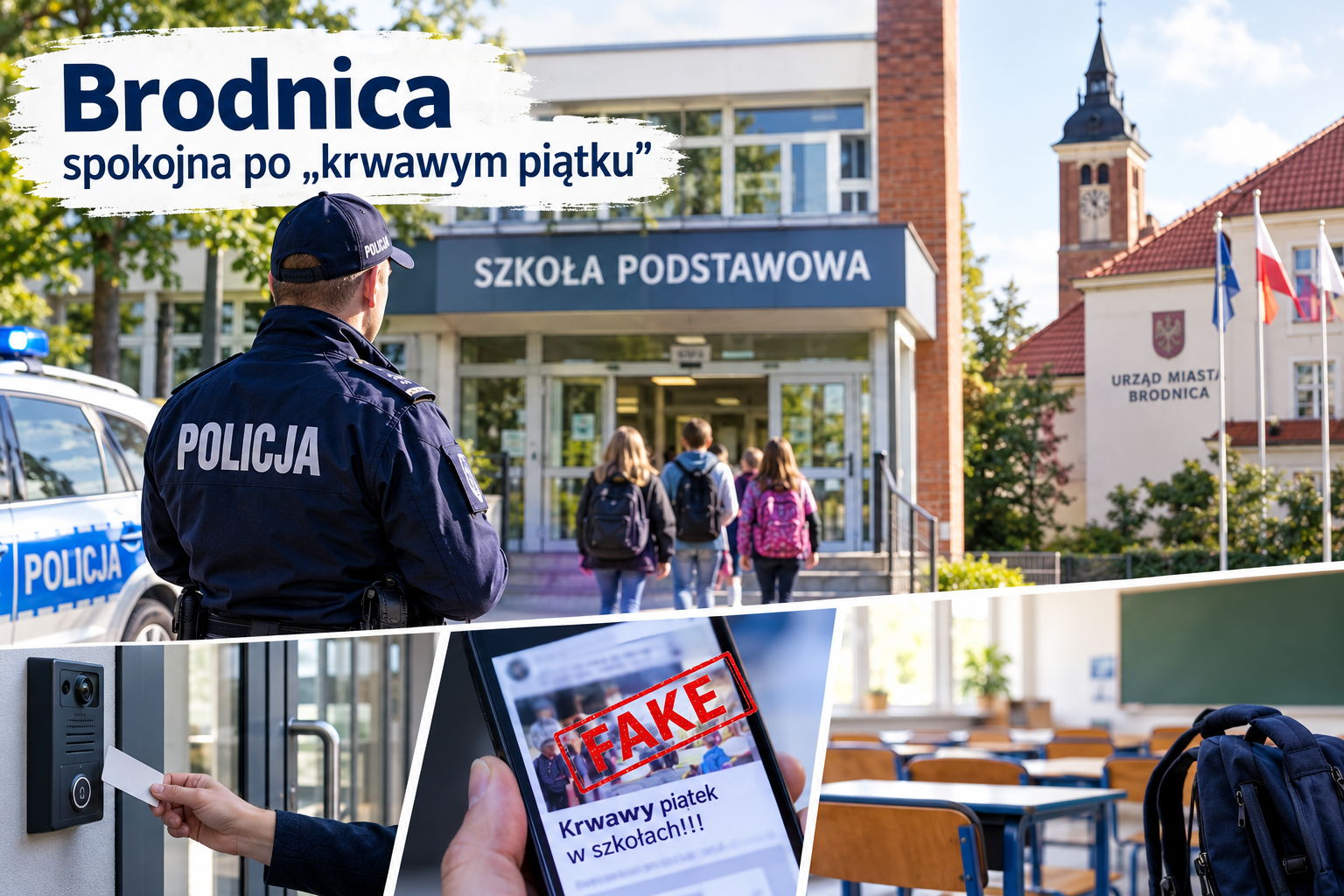
Brodnica Prioritizes Safety. Schools React, Parents Make Difficult Decisions
Disturbing reports about the alleged 'Bloody Friday' caused a stir among parents, students, and teachers. Brodnica's schools introduced additional safety rules, services increased vigilance, and some parents decided to keep their children at home. In this situation, one thing is worth appreciating: the responsible reaction and concern for the safety of the youngest.
In recent hours, many alarming pieces of information circulated on social media and messengers regarding an alleged online challenge. As indicated by the police statement, current findings did not suggest that the announced event would actually take place. However, the matter was analyzed by the services, and police officers responded to disturbing signals.
In Brodnica, as informed by Mayor Jarosław Radacz, the situation was monitored in cooperation with the services, and increased police and Municipal Guard forces appeared in the vicinity of schools.
Schools Did Not Wait to Act
Brodnica's educational institutions deserve recognition for taking the situation seriously and reminding everyone of safety rules. An example is Primary School No. 2 in Brodnica, which announced restricted access to the building, control of entrances, and new rules for bringing and picking up students. Separate procedures were defined for the common room. The school also appealed to parents to pay attention to items brought by children and their online activity.
A similar approach is visible in the kindergarten's communication, which described rules for controlled handover of children to staff and restrictions on entry for outsiders.
These are concrete actions that help organize the functioning of institutions during heightened anxiety. They do not mean that the threat has been confirmed, but they show that student safety is treated as a priority. Directors, teachers, and school staff deserve credit for this.
Parents Who Kept Their Children Home Also Had Their Reasons
Not all parents decided to send their children to school that day. This is hardly surprising. In the face of uncertainty, some guardians decided that providing childcare at home would be a calmer solution.
They should not be hastily criticized for this. Such decisions often stem from natural concern, and the organizational capabilities of individual families vary. A smaller number of students might also have made it easier for schools to organize work and implement additional procedures, although there is no basis to assume this happened in every institution.
The most important thing is to make similar decisions based on reliable information and school recommendations, and not solely under the influence of emotions.
Warning Others? Yes, But Wisely
It is also worth looking with understanding at people who forwarded disturbing messages. Not everyone who shares a warning wants to cause panic. Often, they are driven by concern for loved ones and the belief that it is better to inform others so they can also remain vigilant.
Simply informing about a potential threat is not the problem. The problem begins when unverified rumors are presented as certainty.
Therefore, it is worth checking sources, following police and school announcements, and avoiding sharing sensational recordings without confirming their authenticity. If information turns out to be false, it should be just as firmly corrected. Consciously creating false alarms is completely different from acting in good faith, although unverified messages can also unnecessarily increase fear.
Common Goal: Children's Safety
The situation in Brodnica reminds us how important cooperation is between schools, parents, local government, and services. It is worth talking to children about disinformation, teaching them a critical approach to online content, and showing them where to find reliable information.
There is no need to choose between ignoring disturbing signals and panic. One can remain calm and act responsibly at the same time.
We thank everyone who cares for the safety of Brodnica's students. Directors and staff of institutions for their readiness to act, services for their vigilance, and parents for their concern for children. In such moments, common sense, reliable information, and mutual understanding are most important.